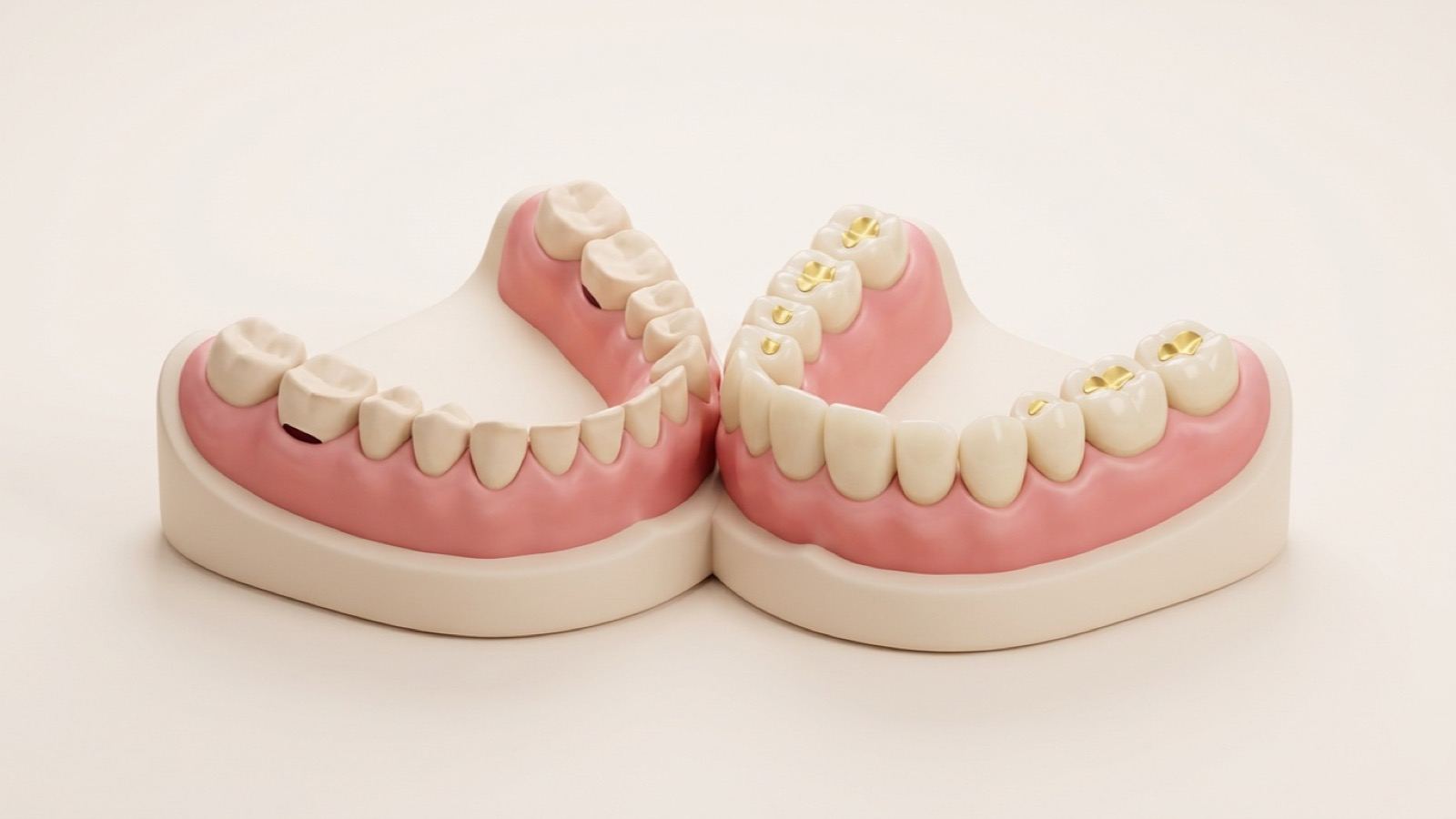
 AI illustration
Full-Mouth Rehabilitation for Severe Tooth Wear
By Dr. Arvind Sahu, BDS, MDS (Prosthodontics & Crown & Bridge) · Registration No. 20407A • Ludhiana, Punjab
Understanding tooth wear, bruxism, and bite collapse
Severe tooth wear occurs when chronic sleep bruxism (clenching and grinding), dietary acid erosion, or missing back teeth systematically wear away protective enamel. As teeth shorten, the lower jaw closes further than normal, causing a loss of Vertical Dimension of Occlusion (collapsed bite height).
Key indicators of occlusal collapse:
- Shortened Front Teeth: Noticeable loss of natural tooth length, chipped biting edges, and a flattened, aged smile line.
- Facial Profile Changes: A sunken lower third of the face, deepening folds around the corners of the mouth, and an older facial appearance resulting from reduced skeletal jaw support.
- Jaw Joint & Muscle Fatigue: Chronic tension headaches in the morning, stiff jaw muscles, and clicking or soreness in the temporomandibular joints (TMJ).
- Chewing Inefficiency: Difficulty chewing fibrous foods because worn, flat biting tables no longer shear food effectively.
Why full-mouth rehabilitation is an MDS Prosthodontic specialty
Restoring a collapsed bite cannot be treated by simply placing crowns on individual teeth one by one. It requires full-mouth rehabilitation—a comprehensive prosthodontic discipline that re-engineers your entire bite relationship, jaw kinematics, and facial aesthetics into a stable, balanced chewing system.
Why specialized prosthodontic training is essential:
- Specialist Training: Dr. Arvind Sahu completed three years of intensive postgraduate hospital residency in Prosthodontics & Crown and Bridge, the specialty recognized for complex occlusal reconstruction.
- Occlusal Mechanics: If a crown is placed even half a millimetre too high or incorrectly angled, it can cause severe muscle fatigue, chipped porcelain, or joint dysfunction.
- Diagnostic Instrumentation: Prosthodontic planning utilizes facebow transfers, semi-adjustable articulators, and digital X-rays to map your jaw movements, centric relation, and chewing envelope before any permanent restoration is crafted.
The clinical stages of rebuilding your bite
Full-mouth rehabilitation is carried out in systematic, predictable stages. The newly calculated bite height is first tested and adapted using reversible temporary restorations before any permanent crowns are fabricated, ensuring complete comfort for your jaw joints and muscles.
The staged clinical protocol: 1. Comprehensive Examination & Bite Records: Clinical evaluation (₹300) and radiographic assessment map remaining tooth structure, pulp vitality, and periodontal bone levels. 2. Diagnostic Wax-Up & Trial Phase: Highly precise diagnostic wax models simulate the restored bite. Patients wear an occlusal appliance or temporary composite overlays for 4 to 8 weeks to confirm jaw joint comfort, relaxed facial muscles, and clear phonetics at the new bite height. 3. Definitive Crown & Bridge Fabrication: Once the bite is clinically verified, individual teeth and bridges are prepared. Back chewing molars are typically restored with high-strength Monolithic Zirconia (from ₹4,000 per tooth) or PFM crowns (from ₹2,000 per tooth) to withstand heavy mastication, while front teeth receive aesthetic ceramic restorations. 4. Implant Integration (When Missing Teeth Exist): If posterior molars were previously lost, dental implants are integrated into the arch to establish solid bilateral posterior support, protecting front teeth from destructive shear forces. 5. Protective Night Guard: A custom-milled hard occlusal night guard is provided to shield the new restorations from unconscious nighttime clenching.
Materials engineered for high bite forces: Zirconia vs. PFM
In full-mouth rehabilitation, material selection is critical to prevent future chipping. High-strength Monolithic Zirconia is the material of choice for heavy bruxers because it is milled from a solid ceramic block with no porcelain layer to chip or delaminate.
Material comparisons for full-mouth reconstruction:
- Monolithic Zirconia (from ₹4,000/tooth): Offers flexural strength exceeding 1,000 MPa, smoothly polished to be gentle on opposing teeth while completely resisting chipping under heavy chewing forces.
- Porcelain-Fused-to-Metal (PFM, from ₹2,000/tooth): An established, cost-effective option featuring an inner metal core, useful in select posterior segments where high aesthetic translucency is less critical.
- Itemized Written Estimates: Because every rehabilitation requires an individualized combination of crowns, onlays, and potential implants, full-mouth reconstruction costs are explained in a written estimate after clinical examination.
Planning your rehabilitation with Dr. Arvind Sahu in Ludhiana
Living with severely worn, chipped, or painful teeth reduces nutrition, comfort, and self-confidence. A structured prosthodontic evaluation provides clarity on how your bite can be restored safely and predictably.
RedCity Dental Care & Implant Centre is conveniently situated at 47 A/1 South Model Gram, Ludhiana (near South Model Town), easily accessible from Model Town Gol Market, Pakhowal Road, Sarabha Nagar, and Dugri.
Dr. Arvind Sahu (BDS, MDS Prosthodontics & Crown and Bridge, Reg. No. 20407A) personally conducts every phase of treatment planning. To discuss your case, send 3 clear photos of your bite (front smile, upper chewing surfaces, lower chewing surfaces) on WhatsApp to +91 76268 58230 and Dr. Sahu will reply with a voice message (this is not an automated diagnosis), or call +91 76268 58230 to schedule your in-person consultation.