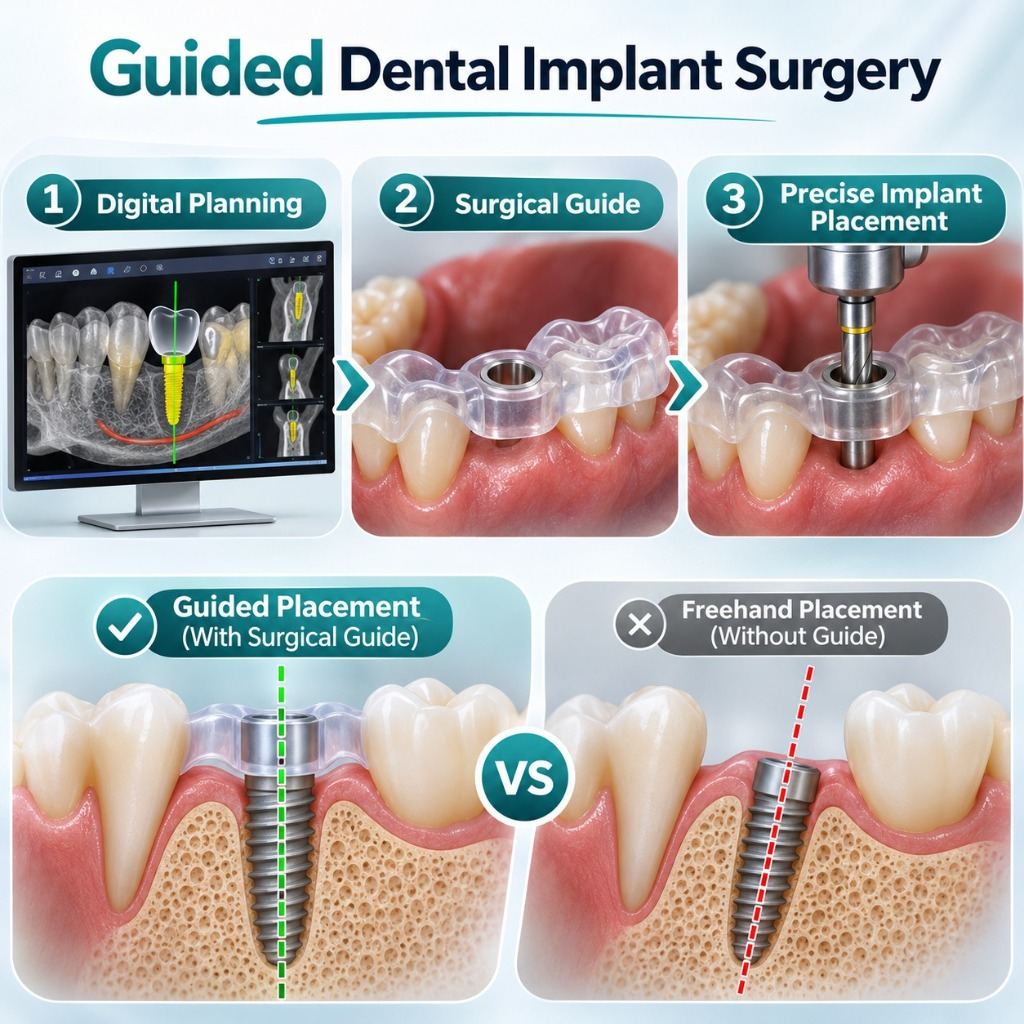
 AI illustration
Guided Dental Implant Surgery vs. Freehand: The Ruler Analogy
By Dr. Arvind Sahu, BDS, MDS (Prosthodontics & Crown & Bridge) · Registration No. 20407A • Ludhiana, Punjab
The ruler analogy: Guided vs. freehand placement
To understand the difference between conventional and guided implant placement, consider drawing a straight line on paper. If you draw freehand, you can produce a line that looks reasonably straight, but minor deviations inevitably occur. If you hold a rigid ruler against the paper and guide your pen along its edge, the line is straight, measured, and placed exactly where intended. Guided dental implant surgery functions as that clinical ruler.
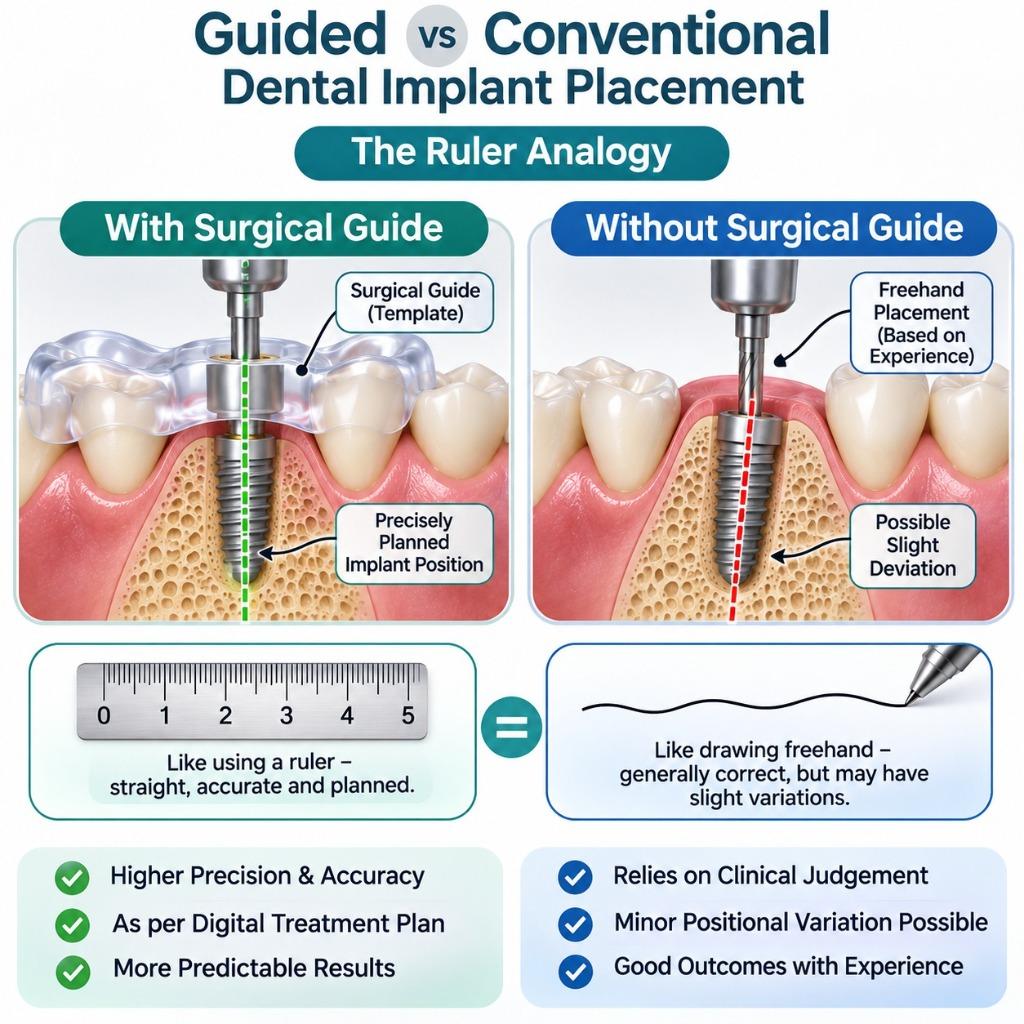 AI illustration
In implant dentistry, sub-millimetre precision matters. A dental implant must be anchored securely within solid jawbone while maintaining a safe distance from vital nerves, blood vessels, sinus cavities, and adjacent tooth roots. Guided surgery translates pre-operative digital scans into physical guidance during the procedure.
Understanding conventional freehand implant placement
In conventional freehand placement, the clinician studies diagnostic 2D X-rays or 3D scans before the procedure and then relies on manual visual judgment and tactile sensation to position the implant during surgery.
How freehand placement operates in practice:
- Mental Spatial Translation: The dentist evaluates bone contours on a computer screen and mentally projects that three-dimensional plan into the patient's mouth.
- Operator-Dependent Alignment: The entry point, angle, and drilling depth are determined by hand-eye coordination during the osteotomy.
- Anatomical Margins: While experienced clinicians regularly achieve successful integration with freehand methods, published surgical literature documents that positional shifts and minor angulation variances can occur without physical drill stops.
- Flap Reflection: Freehand surgery generally requires reflecting a wider gum flap so the clinician can directly visualize the underlying bone ridge.
What computer-guided dental implant surgery involves
Guided dental implant surgery combines three-dimensional anatomical imaging with computer-aided design and 3D printing to create a custom surgical template before surgery begins.
The core components of guided surgery: 1. 3D CBCT Bone Imaging: A cone-beam computed tomography scan generates a sub-millimetre volumetric map of your jaw, displaying bone height, width, density, the inferior alveolar nerve canal, and maxillary sinus floors. 2. Digital Intraoral Optical Scanning: An optical scanner captures digital impressions of your existing teeth, gums, and bite relationship without messy impression trays. 3. Prosthetically Driven 3D Planning: In specialized planning software, the digital teeth and bone scans are merged. The final crown is designed first in its ideal chewing and aesthetic position, and the underlying implant is planned beneath it to support that exact crown. 4. Custom 3D-Printed Surgical Guide: A rigid, biocompatible surgical template is fabricated with precision titanium drill sleeves. During surgery, this guide rests securely over the teeth and gums, physically directing each drill bit to the predetermined depth, angulation, and coordinate.
Key clinical differences: Freehand vs. guided surgery
Comparing the two surgical methodologies highlights how digital planning shifts technical decision-making from the operating chair to pre-surgical preparation.
Direct comparison of approaches:
- Pre-Operative Planning: Freehand relies on mental visualization from radiographs; guided surgery utilizes a complete 3D virtual simulation with crown-first design.
- Drill Trajectory & Depth: Freehand relies on manual hand stability; guided surgery employs mechanical stops within metal sleeves that physically prevent over-drilling or angular deviation.
- Gum Tissue Management: Freehand typically requires wider incisions to visualize bone contours; guided surgery often allows minimally invasive micro-incisions or flapless punch techniques when bone volume is sufficient.
- Procedural Duration: Because angles and depths are locked into the guide beforehand, the active surgical stage in guided procedures is often more efficient and streamlined.
- Prosthetic Emergence: Guided placement ensures the implant emerges in the exact centre of the planned crown, facilitating clean screw-retained restorations without awkward angles.
Clinical advantages of digitally guided placement
Utilizing a custom surgical guide provides tangible clinical benefits, particularly in delicate anatomical areas and complex restorative cases.
Primary advantages for patients:
- Vital Nerve and Sinus Safety: Digital planning establishes a safety boundary around the inferior alveolar nerve and maxillary sinus, with physical drill stops preventing accidental encroachment.
- Reduced Post-Operative Soreness: When performed flaplessly or with micro-incisions, soft tissue trauma is minimal. Patients experience less swelling, reduced bleeding, and a more comfortable recovery period.
- Screw-Retained Crown Alignment: Implants positioned with digital precision align directly with the chewing surfaces of opposing teeth, enabling screw-retained ceramic crowns that do not require subgingival dental cement.
- Predictable Multi-Tooth Alignment: When placing multiple adjacent implants or planning full-arch restorations, guides ensure every fixture remains parallel for uniform bite force distribution.
Local anaesthesia and what the procedure feels like
Dental implant placement is performed comfortably under local anaesthesia. The surgical site, surrounding gum tissue, and underlying nerve pathways are numbed completely using standard dental local anaesthetics.
What patients experience during the visit:
- During Surgery: You remain awake and comfortable. You will feel light vibration and gentle water irrigation from the dental handpiece, along with firm tactile pressure, but no sharp discomfort.
- After the Anaesthesia Wears Off: Mild post-operative tenderness or a dull ache in the gum tissue is normal for 48 to 72 hours. This is manageable with standard oral pain relievers and salt-water rinses.
- Healing Timetable: The titanium implant requires 3 to 4 months of undisturbed healing to fuse solidly with your bone (osseointegration) before the final permanent ceramic crown is attached.
When is guided implant surgery particularly indicated?
While straightforward cases with abundant bone can be treated freehand by experienced hands, guided surgery is beneficial in several clinical situations.
Specific clinical indications:
- Proximity to Critical Structures: When the jawbone ridge has limited height above the lower jaw nerve or beneath the maxillary sinus.
- Front Aesthetic Zone: Where even a single millimetre of facial or lingual deviation changes the gum contour and symmetry of a front tooth.
- Tight Interdental Gaps: Replacing a single missing tooth between closely spaced natural tooth roots where drill clearance is minimal.
- Full-Arch Restorations: Rebuilding an entire upper or lower arch with multiple implants that must seat a rigid cross-arch prosthesis.
In-house prosthodontic planning with Dr. Arvind Sahu in Ludhiana
The clinical outcome of dental implant therapy depends on restorative planning—ensuring the titanium fixture supports a durable, natural-looking crown that balances your bite. Because Dr. Arvind Sahu holds an MDS in Prosthodontics & Crown and Bridge, every implant case at RedCity Dental is planned prosthetically from crown to root.
RedCity Dental Care & Implant Centre is located at 47 A/1 South Model Gram, Ludhiana (near South Model Town), easily accessible from Model Town Gol Market, Pakhowal Road, Sarabha Nagar, Dugri, and Ferozepur Road.
Transparent pricing policy:
- Dental Implants: From ₹18,000 per implant, based on bone anatomy and selected fixture specifications.
- Comprehensive Consultation: ₹300 clinical examination.
- Written Itemized Estimates: You receive an itemized breakdown outlining each stage before treatment begins.
To discuss whether guided implant placement is suitable for your missing teeth, send 3 clear photos of your smile via WhatsApp to +91 76268 58230. Dr. Sahu will personally review your photos and send you a voice message — this is not an automated diagnosis.
Related: Dental Implants in Ludhiana